


I developed the following wark for Democratic Society, within the framework of the AI for Democracy working group, a collective effort under the NETS4DEM project.
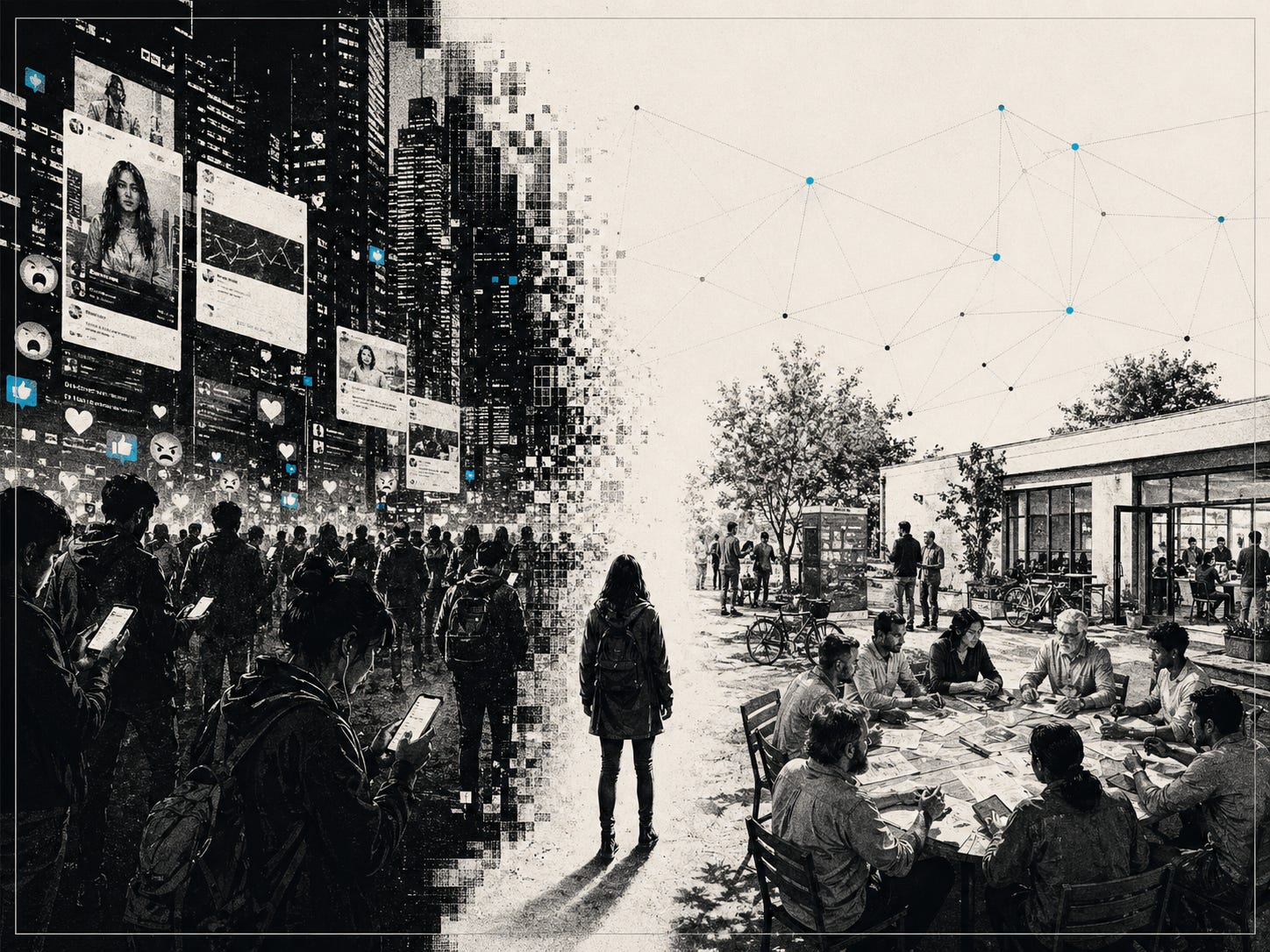
Here, we explore the erosion of digital democracy in the age of corporate AI, where algorithms and extractive platforms have turned public discourse into a monoculture of outrage and dependency. But rather than surrendering to centralized control, we propose a path forward: federated networks, local AI, and productive friction as the foundations for reclaiming civic space. This article synthesizes our reflections on how to design democratic technologies that serve people, not platforms.
The Trap of “Zero Friction”
We were sold a future where everything would be instant: a click to participate, an algorithm to decide, an AI to govern. But behind this promise of convenience lies a trap: the systematic delegation of our agency to systems designed to maximize corporate control. The “frictionless” user experience is not neutral; it’s the design of a dopamine cage, where civic participation is reduced to emotional reactions, likes, and shares, while genuine deliberation—necessarily slow, uncomfortable, and complex—disappears.
How Did We Get Here?
Let’s turn to the Greek myth of Heracles at the crossroads to understand it better:
Kakia (the path of comfort): Promises a life without obstacles. In the digital world, this translates to platforms that eliminate friction to retain our attention, designed for addiction, not reflection. Democracy in this scenario becomes passive, vulnerable to manipulation, and ultimately a game of algorithms that prioritize conflict and engagement over the common good.
Arete (the path of virtue): Requires effort. In digital democracy, this means productive friction: slow debate, long documents, consensus built over time and conflict. Friction is not a defect but a requirement for the resilience of institutions and collective cognition.
Enshittification: How Platforms Become Cages
Between the promise of comfort (zero friction) and the surrender of power to corporations (the Control Plane), there’s a process the activist Cory Doctorow calls “enshittification”: the systematic degradation of digital platforms, which shift from being useful to extractive, from attracting users to enslaving them, and from prioritizing the common good to maximizing profit for a few. This cycle is not accidental; it’s designed to make platforms indispensable, and once they achieve that, to exploit that dependency until the public sphere is emptied of everything that made it valuable.
The Three Phases of Enshittification
Doctorow describes a pattern that repeats across centralized platforms in almost every digital sector:
Phase 1: The Trap of Attraction (Initial Losses)
Corporations enter a market by offering services at a loss or with seemingly generous conditions.
Example 1: Blogs vs. Social Media
In the 2000s, blogs were spaces for deep reflection and digital sovereignty: they required effort (writing, reading long texts, maintaining servers with tools like RSS), but allowed citizens to control their own voices and data. Social media (Facebook, Twitter, Instagram) arrived promising instant visibility and for free. At first, bloggers used these platforms as megaphones to redirect traffic to their blogs (e.g., sharing links on Twitter). Convenience won: people stopped reading full articles, stayed in headlines, and eventually abandoned their blogs to publish directly on social media.
Result: Social media gained traffic, but blogs lost autonomy and depth.
Example 2: Amazon and E-Commerce
Amazon started with rock-bottom prices, free shipping, and an apparently unlimited selection, destroying local bookstores and small competitors. For consumers, it was a blessing: everything cheaper and faster. But behind this facade, the platform captured purchase data, habits, and preferences without users’ knowledge.
Phase 2: Capturing Attention (Value Extraction)
Once platforms have addicted users and eliminated competition, they change the rules to extract value.
Example 1: Social Media and the Algorithm of Conflict
Facebook and Twitter stopped being places to share links and became machines for emotional engagement. Their algorithms prioritize conflict, outrage, and virality because they generate more screen time and, thus, more advertising. What was once a diverse public space became a monoculture of outrage.
Impact on democracy: Debates are reduced to 280 characters, news is shared without context, and polarization is monetized. The public sphere degrades.
Example 2: Amazon and the Enslavement of Sellers
Once Amazon had centralized demand, it forced sellers to use its marketplace to survive. Today, small businesses pay up to 50% of their profits in commissions and advertising within the platform. The most visible products are not the best, but the ones that pay for advertising.
Result: A degraded catalog where sponsored products drown out the relevant.
Phase 3: Total Exploitation (Monoculture and Maximum Extraction)
In the final phase, the platform no longer needs to hide its extractive nature because users and sellers have no alternatives.
Example 1: Social Media as “Attention Extractors”
Instagram, TikTok, and YouTube reduce organic content to show only ads and sponsored content. Creators depend on opaque algorithms that decide who gets visibility and who doesn’t, with no transparency. The sovereignty of the creator disappears.
Consequence for democracy: Citizens stop being political subjects and become objects of advertising.
Example 2: Amazon and the “All-Inclusive” Model
Today, Amazon doesn’t just sell products; it controls logistics, payments, storage, and even advertising. Sellers can’t escape because there’s no viable alternative. Consumers can’t either, because Amazon is the only option for many products.
Result: An ecosystem where everyone loses except Amazon.
Why Does This Matter for Democracy?
Enshittification isn’t just a problem for social media or e-commerce platforms; it’s a mechanism that repeats in corporate AI. When public administrations adopt tools like Google Workspace, Azure AI, or “AI-driven governance” systems from private providers, they’re ceding control of their processes to infrastructures designed to extract value, not to serve the common good.
Phase 1: Governments use these tools because they promise efficiency and automation (e.g., chatbots for citizen services).
Phase 2: They discover that algorithms prioritize conflict and advertising over transparency (e.g., predictive justice systems that reinforce biases).
Phase 3: There’s no turning back: the system depends on a corporation that isn’t accountable.
AI as Infrastructure of Power: The “Control Plane”
The real battleground isn’t the sophistication of language models, but the Control Plane: the infrastructure where data, processes, and decisions are orchestrated. Companies like Google no longer sell chatbots; they sell the operating system where autonomous agents govern bureaucracy. If public administrations adopt these systems without scrutiny, we’ll surrender decision-making power to corporations that answer to no one.
At events like Google Cloud Next 2026, the corporation has shifted from positioning itself as an AI tool provider to presenting itself as the operating system of the “agentic organization”: an environment where models like Gemini stop being chatbots to become layers of orchestration, governance, and connection. In this architecture, traditional tools like Google Workspace are no longer the main product, but merely a canvas where users supervise the agents operating in the background.
If a public administration adopts this model without restrictions, it will delegate decisions, information scrutiny, and bureaucratic execution to a proprietary environment. The result is clear: the corporation becomes the absolute arbiter of the public sphere.
Democratic Hormesis: The Dose That Strengthens
Democracy needs friction. But not just any friction: the kind that strengthens, not the kind that paralyzes. The concept of hormesis, borrowed from biology—where small doses of a stressor (like exercise) strengthen the organism—may be the key to designing resilient civic systems in the digital age.
What Is Democratic Hormesis?
It’s the principle that controlled exposure to productive tensions (such as rigorous debate, reading complex texts, or negotiating consensus) strengthens a society’s ability to withstand crises and manipulation. In the 21st century, this translates to:
Productive friction:
Slow debate: Spaces where time isn’t a luxury but a resource for depth (e.g., citizen assemblies with prior documents and human moderation).
Accessible but not simplified documents: Clear public information, but one that demands cognitive effort to be fully understood (e.g., participatory budgets with detailed data).
Consensus building: Processes where disagreement isn’t resolved with instant polls, but with iterative deliberation.
Technology as a facilitator, not a substitute:
Tools that reduce technical friction (e.g., intuitive interfaces for accessing public data) but preserve civic friction (e.g., forums where arguments develop in long threads, not in 280-character responses).
Auditable and local systems:
Open-source AI models, hosted on community servers, allowing citizens to verify how decisions are made without delegating that responsibility to opaque algorithms.
The Risk: From Hormesis to Asphyxiation
The principle of hormesis is clear: the dose makes the poison. If friction is excessive—if participating in digital democracy requires being an AI engineer—we’ll push most citizens toward corporate platforms out of sheer usability needs. This doesn’t just exclude; it fuels populism, which promises to eliminate friction (and with it, democratic complexity) in exchange for emotional loyalties.
The Role of Professionals: Architects of Sovereignty
The solution isn’t for every citizen to become an AI expert; it’s for professionals and organizations dedicated to civic design to take an active role:
Designing local AI tools that are accessible but protect spaces for human decision-making.
Auditing language models (such as Small Language Models) to ensure transparency and privacy.
Building “Dark Forests”: federated and local networks that act as shields against corporate extraction.
The Dark Forest: Federated Networks and Digital Sovereignty
The metaphor of the “Dark Forest”—inspired by science fiction, where dark forests are spaces where predators don’t enter—applies here as a strategy to protect digital sovereignty. It’s about:
Federated local networks: Decentralized systems (like Mastodon, PeerTube, or Matrix) where communities host their own servers, avoiding the concentration of data in the hands of tech giants.
Community AI: Small language models (SLMs) trained on local data and hosted on community infrastructure, ensuring that algorithms reflect the values of the community, not the interests of shareholders.
Resistance perimeters: Digital spaces where data extraction is impossible because there’s no centralized Control Plane to be captured.
This approach isn’t a utopia; it already exists. Projects like Lemmy, WriteFreely, or ActivityPub demonstrate that building decentralized alternatives that prioritize privacy, transparency, and autonomy is viable. The key is to stop seeking global solutions and start building local, resilient, and connected networks.
Open Source as a Safeguard
The viability of this ecosystem isn’t a utopia but a reality within reach of administrations and civil society. Current open-source models (like Mistral or Qwen) already compete in sophistication with proprietary systems. The difference: they allow auditing, modification, and local hosting of AI, ensuring confidentiality and autonomy.
Final Reflection: What Democracy Do We Want?
Beyond technology, there’s a fundamental question: What kind of society are we building when we delegate our capacity for decision-making to opaque systems designed to maximize profit?
Democracy is not an algorithm. It’s not an AI that synthesizes opinions in real time. Democracy is a slow, uncomfortable, and collective process where conflict, negotiation, and consensus are its pillars. When we eliminate friction, we don’t just lose sovereignty; we lose the very essence of what it means to govern ourselves.
Technology can be a tool of liberation or oppression. Everything depends on who controls the infrastructure and for what purposes. Today, power isn’t disputed in Silicon Valley’s servers, but in our ability to imagine—and demand—a future where AI serves democracy, not the other way around.
Democratic Hormesis: The Dose That Saves
Democratic hormesis isn’t an abstract concept; it’s a survival strategy. In a world where algorithms promise democracy without effort, friction becomes the antidote to manipulation and apathy. But for it to work, it must be:
Deliberate: Not left to chance, but designed into civic processes.
Inclusive: Accessible to all, without falling into technical elitism.
Auditable: Transparent in its functioning and its limits.
The challenge isn’t choosing between technology and democracy, but designing technologies that understand their ultimate purpose is to serve democracy, not replace it. As the philosopher Ivan Illich said, “The quintessential tool of man is man himself.” AI is not a magic solution, but a mirror: it reflects the questions we ask it, but not the answers we need.
What do you think?
How could we apply the “Dark Forest” concept in your community or professional environment?
What forms could Democratic Hormesis take?
Do you see any insurmountable obstacles to building these federated networks?
AI for Democracy: The Group’s Roadmap
The AI for Democracy working group is a collective effort to redefine the role of artificial intelligence in civic processes, ensuring that technology serves democracy, not the other way around. Our roadmap is structured around three pillars: Infrastructure, Education, and Advocacy, with the goal of building resilient, transparent, and participatory digital ecosystems.
Work Plan and Future Perspectives
The development process for this contractual shield will follow the quarterly planning outlined below for the year 2026:
First Quarter (April–June): Risk Identification
Typify technical and socio-political risks, with a focus on auditability deficits, technical elitism, and vulnerabilities stemming from outsourcing orchestration to third-party platforms.
Second Quarter (June–September): Regulatory Compilation
Formulate usability and interoperability standards for local AI.
Draft clauses requiring public administrations to retain data sovereignty without compromising citizen accessibility.
Third Quarter (October–December): Instrument Synthesis
Consolidate the study into a concise evaluation tool for standard and mandatory integration into public procurement processes.