
Public Mesh, in Progress
Exploring the Infrastructures of Democratic Life in the Digital Age

I’ve always liked experimenting and sharing my thoughts.
Writing, however, has never felt like the thing I do best.
I’ve never seen myself as a particularly gifted writer in the conventional sense. What comes more naturally to me is exploring ideas, connecting dots, observing patterns, and trying to articulate things that still feel unfinished. In that sense, writing has often been less a performance and more a way of thinking out loud.
The arrival of artificial intelligence has changed that process for me quite significantly.
It has allowed me to experiment much more, both with thinking and with writing. I’ve been able to activate many conversations with different chatbots, test perspectives, challenge my own assumptions, organise fragments of text more clearly, and move from intuition to structure much faster than before. Not because AI replaces the work of reflection, but because it gives me more ways to stay in dialogue with it.
Public Mesh was born precisely out of that experimentation.
Right now, it is probably the place where I am experimenting the most. That is also why it keeps shifting. I am still refining it, still tuning its voice, still understanding myself through the process of giving it form. Public Mesh is not a finished editorial product with rigid boundaries. It is, for now, a living space where I am trying to understand what kind of publication this needs to become.
So today I want to share where I currently am with it.
Not as a final definition, but as a map of its present direction.
Public Mesh as an editorial field
Public Mesh is an editorial project about the infrastructures that shape public life.
It lives at the intersection of democracy, technology, civic design, culture and collective life. It is less interested in reacting to the latest headline than in understanding the deeper transformations that sit underneath the visible surface of current events.
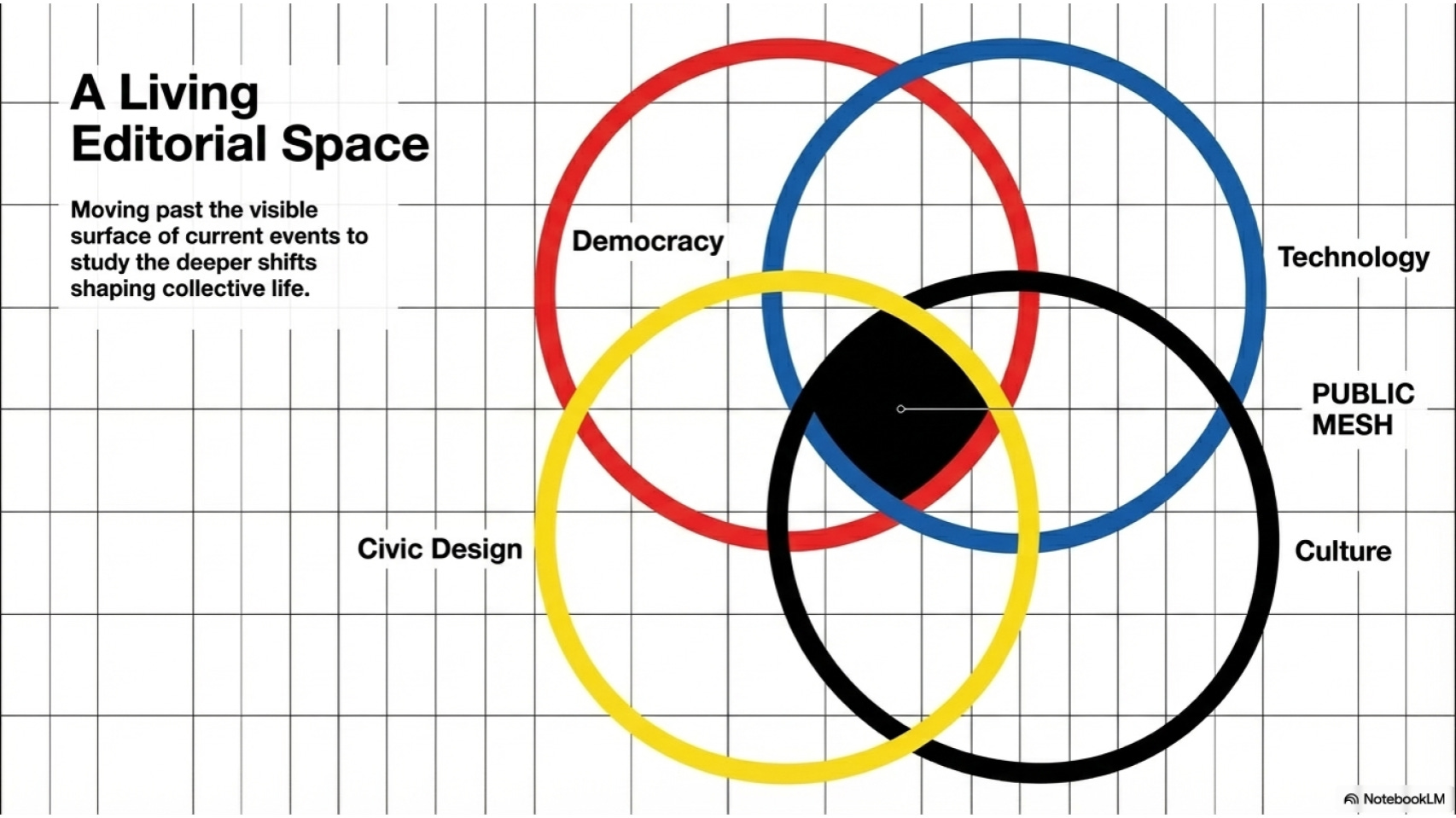
The intuition behind it is simple, although its implications are not.
Many of the crises we are living through are not only political or ideological. They are also infrastructural.
They have to do with the weakening of the spaces where people meet.
The acceleration of rhythms that make collective life harder to sustain.
The concentration of technological systems in the hands of a few actors.
The erosion of those everyday practices that once made democratic life more tangible.
Public Mesh is my attempt to study those shifts and to ask a recurring question:
What infrastructures are needed for democracy to remain alive in the twenty first century?
This does not mean only institutions, laws or policy frameworks. It also means softer layers that are often harder to name. Shared spaces. Cultures of collaboration. Civic rituals. Public trust. Learning environments. Digital infrastructures. Local networks. Collective memory. The forms that allow people not only to coexist, but to make sense of life together.
The current shape of the project
As I try to understand Public Mesh better, I keep returning to a group of recurring themes. They are not separate categories in a strict sense. They overlap, feed one another and sometimes blur into each other. But together they are helping me understand the editorial identity of the project.
1. Democracy as infrastructure
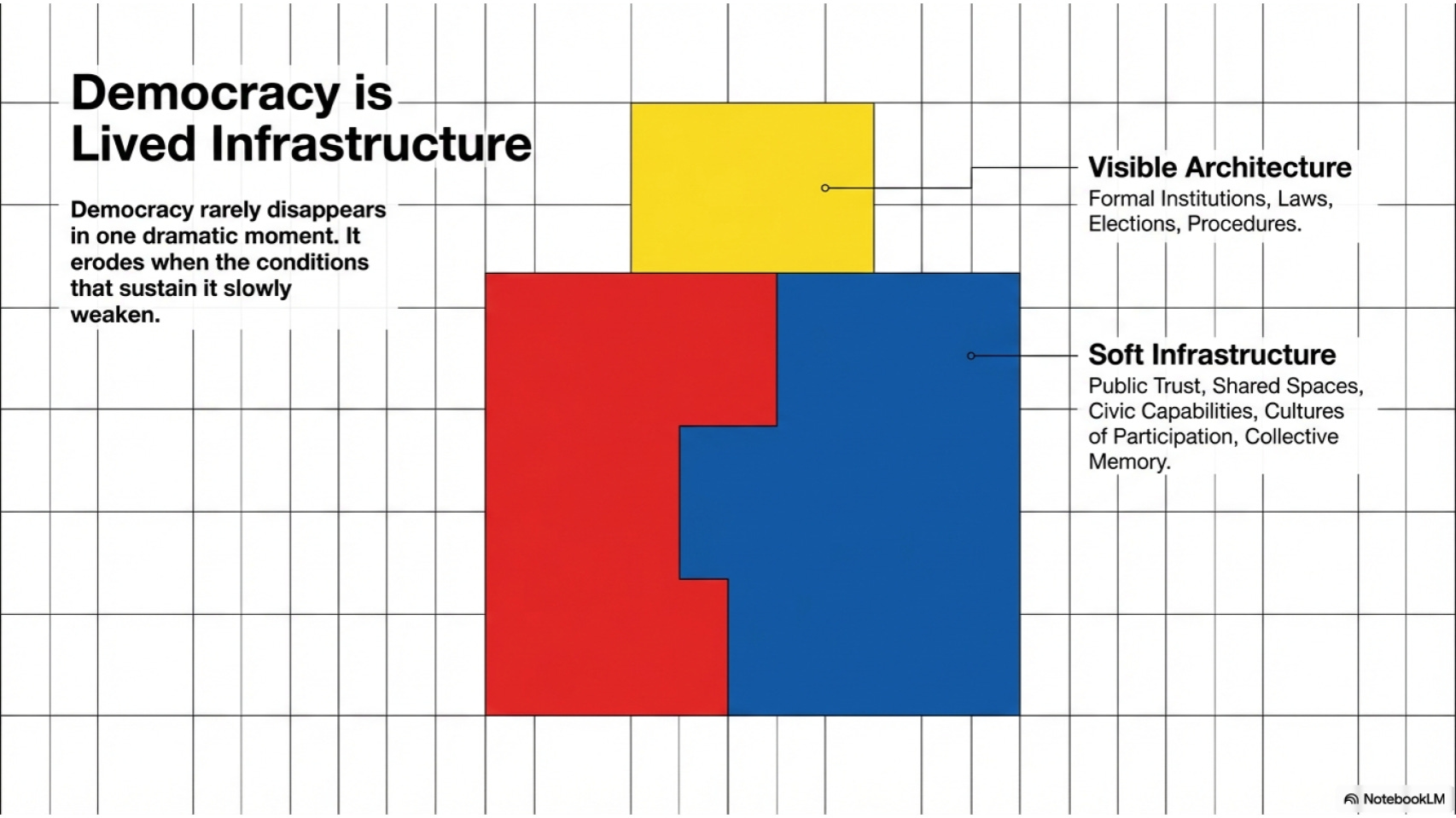
One of the strongest ideas shaping Public Mesh is that democracy is not only a formal system. It is a lived infrastructure.
Democracy rarely disappears in one dramatic moment. More often, it erodes when the conditions that sustain it slowly weaken. Institutions may remain in place, elections may continue, procedures may still exist, but the deeper fabric that allows democratic life to function becomes thinner.
That fabric includes trust, public spaces, civic capabilities, readable institutions, cultures of participation and the possibility of shared meaning.
This is why I am increasingly drawn to the idea that democracy has to be understood infrastructurally. Not only in its visible architecture, but in the softer layers that make participation, deliberation and collective responsibility possible.
2. Spaces where democracy actually happens
A second theme is the importance of the places where democracy is practiced in real life.
Much of political discourse still focuses almost entirely on formal institutions, while paying far less attention to the ordinary environments where public life actually takes shape. Today, the spaces where we most often encounter people different from ourselves are rarely the ones traditionally described as civic. More often, they are the everyday settings of urban life: bars, cafés, gyms, supermarkets, corner shops, public transport, markets, waiting rooms, parks, playgrounds, pharmacies, bakeries, and all those shared spaces where strangers briefly but repeatedly move through the same world.
These places are not usually designed for democratic life, yet they quietly sustain some of its most basic conditions. They expose us to people we did not choose, habits we do not share, accents we do not know, rhythms that are not our own. They force small negotiations, minor frictions, fleeting recognitions and forms of coexistence that are easy to overlook but politically significant.
This matters because democracy does not depend only on institutions, rights or procedures. It also depends on whether a society still contains enough spaces where difference remains visible, ordinary and tolerable. When everyday life becomes too segmented, too personalised or too filtered, public life begins to lose thickness. People no longer meet across difference except through media, ideology or conflict.
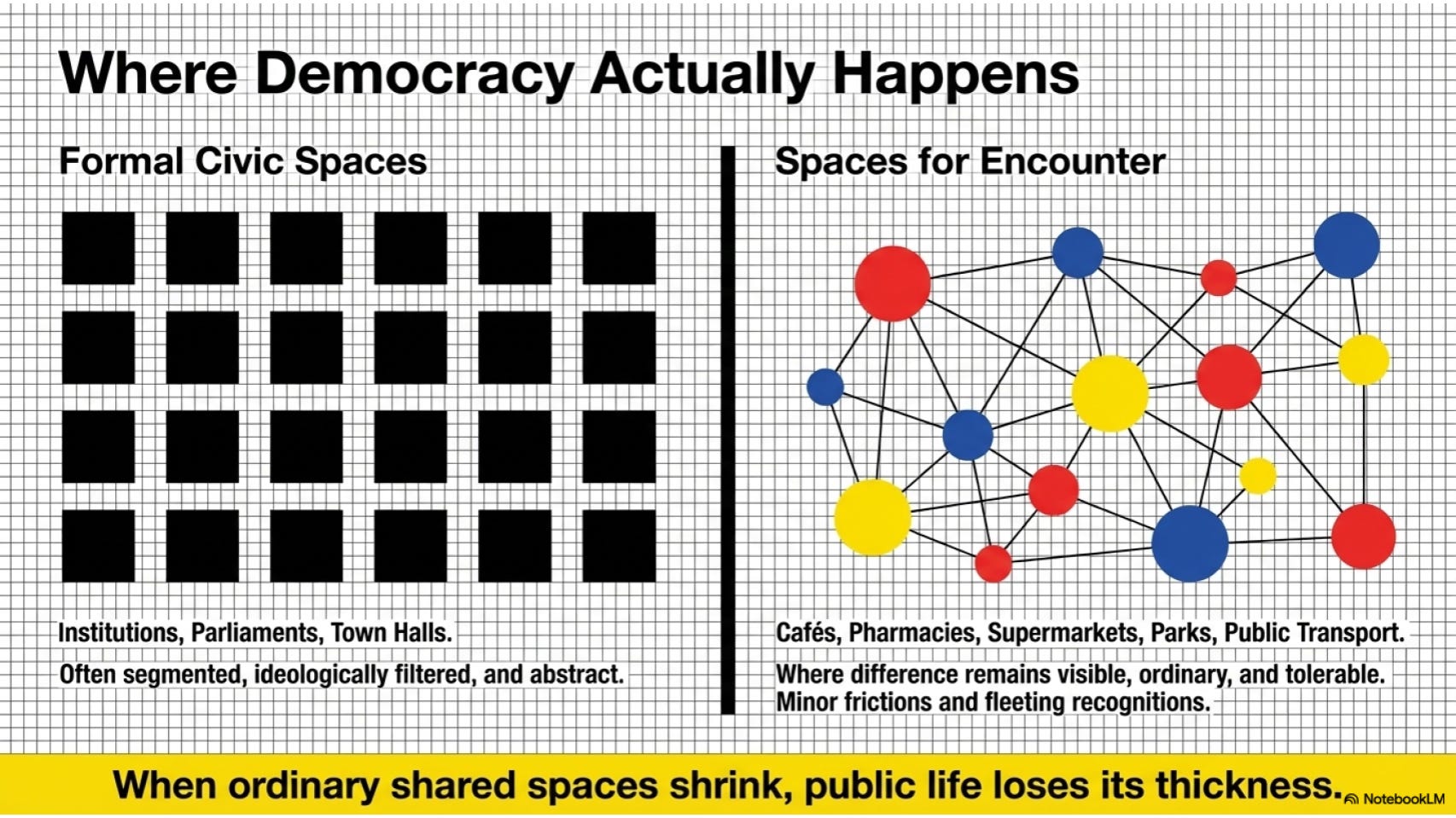
This is where the idea of Spaces for Encounter becomes central for me.
I keep returning to this idea because one of the deepest democratic losses of our time is the shrinking of ordinary spaces where different worlds still meet without needing to agree. When those spaces disappear, democracy is left with procedures but loses texture. Public life becomes thinner, more abstract, and far easier to capture through polarisation, fear or spectacle.
3. From platforms to public infrastructure
Another foundational concern of Public Mesh is the transformation of the internet and of digital life more broadly.
The web once carried the promise of an open and distributed infrastructure. Over time, however, it became increasingly absorbed into platform logics based on extraction, dependency and control. What we call the digital public sphere is now often structured by private incentives that are fundamentally misaligned with democratic life.
This shift matters enormously.
It shapes how attention flows, how knowledge circulates, how conversations are framed and how social behaviours are rewarded. It affects not only communication, but the very conditions of collective life.
So one of the questions Public Mesh keeps asking is what it would mean to move from platform dependency toward something closer to public digital infrastructure. Not as nostalgia for an earlier internet, but as a necessary horizon for democratic renewal.
4. Artificial intelligence and sovereignty
Artificial intelligence has become another key terrain of exploration.
What interests me here is not the hype itself, although the hype is impossible to ignore. It is the way AI has made visible an underlying question that was already there: who controls the infrastructures through which intelligence, knowledge and decision making are increasingly mediated?
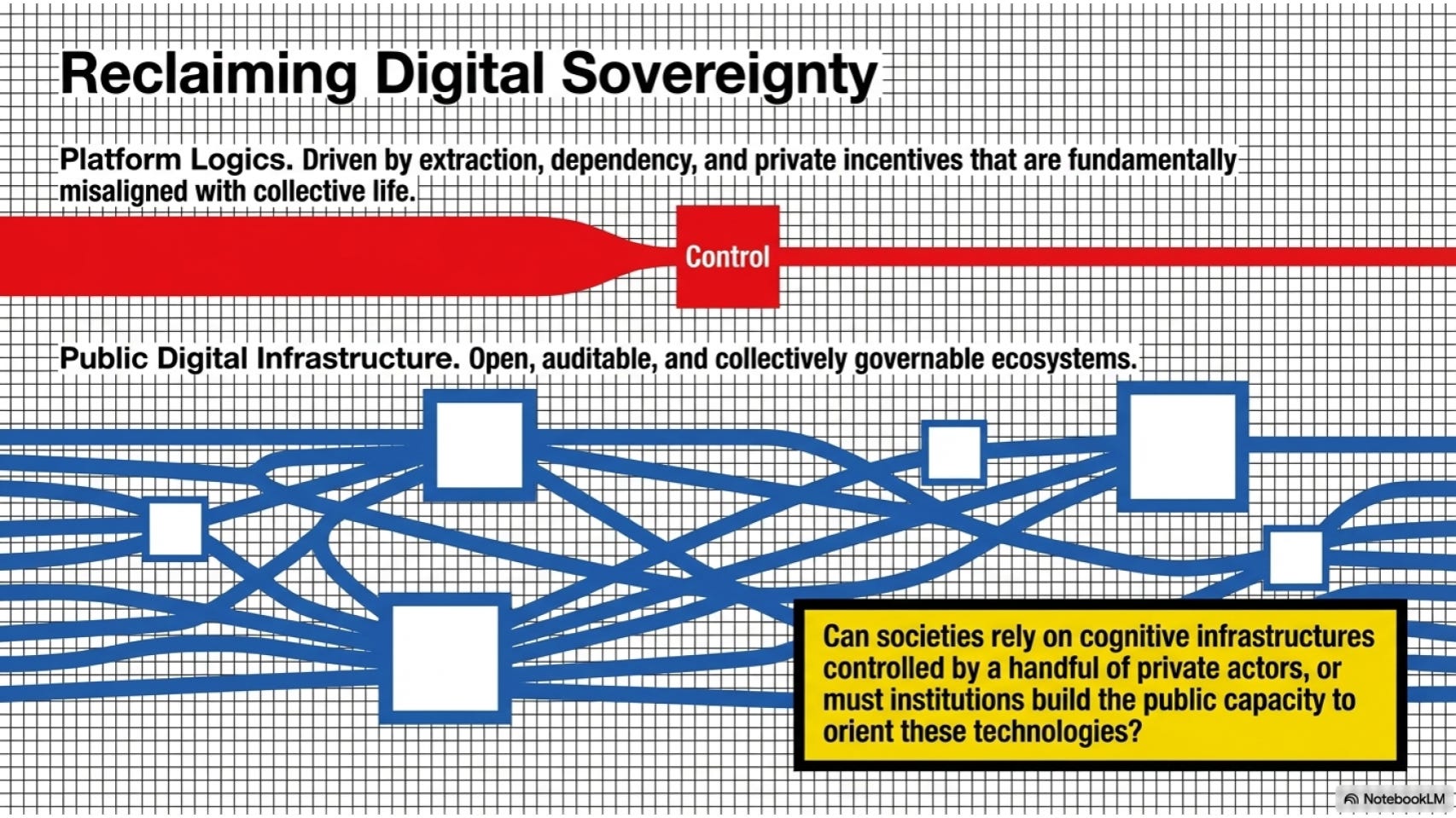
The current AI boom is driven to a large extent by corporate narratives, speculative capital and geopolitical competition. But beneath that there is a deeper question of sovereignty.
Can societies rely on cognitive infrastructures controlled by a handful of private actors?
What would open, auditable and collectively governable AI ecosystems look like?
What kinds of public capacity are needed if institutions want to orient these technologies rather than merely adapt to them?
Public Mesh is becoming one of the places where I explore these questions, especially through the lens of open source ecosystems, public infrastructure and democratic governance.
5. Civic Design beyond participation
Civic Design is another core pillar of the project, although I am increasingly interested in framing it in a more ambitious way.
Too often civic design is reduced to facilitation, consultation or participatory methods. Those things matter, but they do not capture the full depth of the discipline.
What interests me more is civic design as a way of shaping the conditions under which democratic life can happen. A discipline of mediation between citizens, institutions, technologies and territories. A practice that works not only on interfaces or workshops, but on relationships, legibility, coordination and collective capacity.
In that sense, civic design becomes inseparable from the question of democratic infrastructure.
6. Attention, culture and the erosion of the public sphere
The crisis of democracy is not only institutional. It is also cultural and psychological.
The infrastructures of communication shape attention, and attention shapes public life. When communication systems reward speed, outrage, oversimplification and constant stimulation, the consequences are not merely individual. They affect the collective ability to listen, think, deliberate and remain present to complexity.
This is one reason I have become so interested in slower forms of communication and in the broader question of how technologies shape subjectivity.
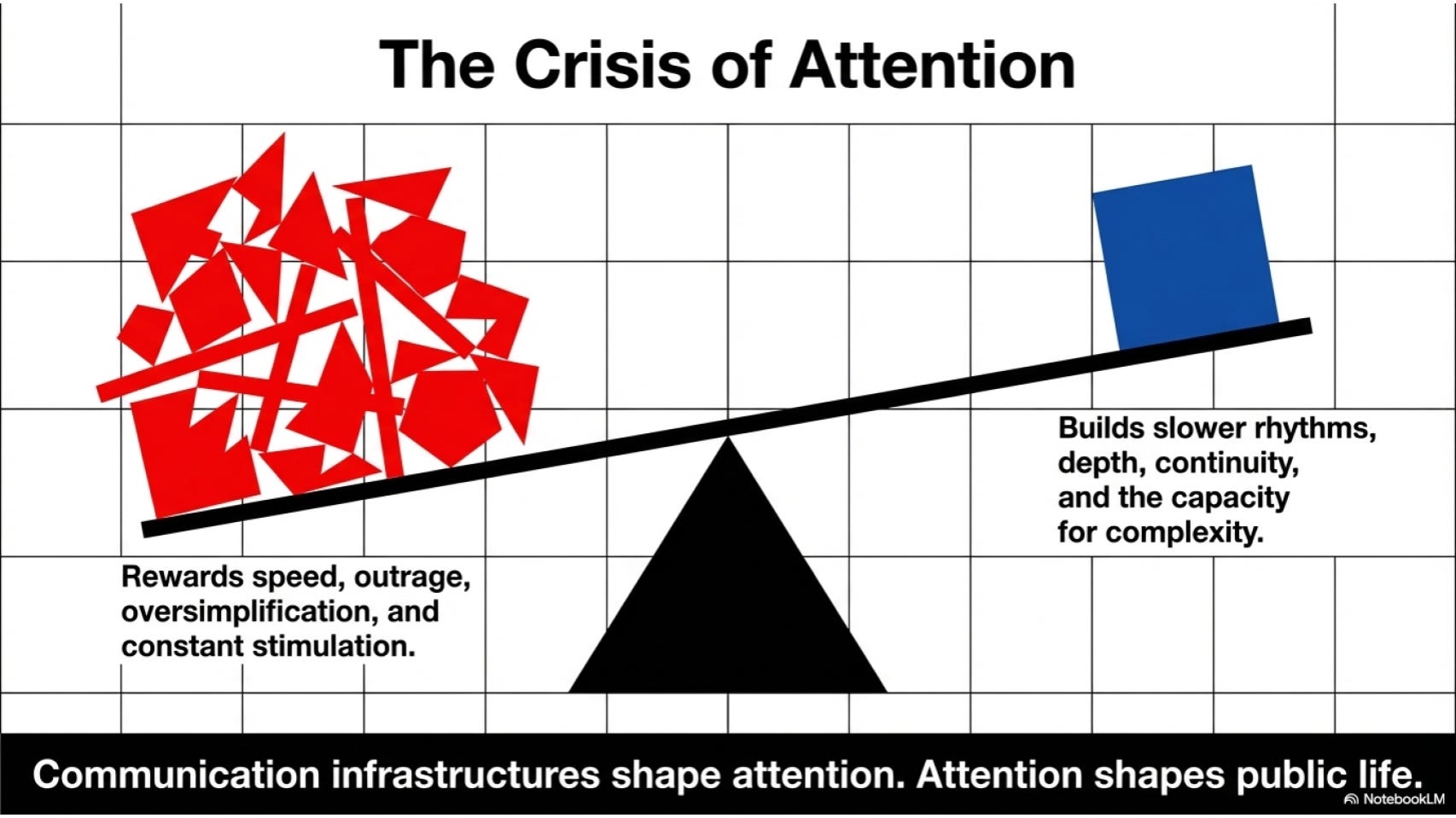
Public Mesh is partly an attempt to understand that erosion. But it is also an attempt to build a different rhythm around thought and exchange. Less reactive. Less optimised for visibility. More oriented toward depth and continuity.
7. Why local experiments matter
Even though many of the forces I am exploring are global, I keep returning to the importance of place.
Cities, neighbourhoods and local ecosystems remain some of the most important laboratories for democratic experimentation. They make it possible to prototype other ways of governing, meeting, learning and organising. They give concrete form to ideas that otherwise remain abstract.
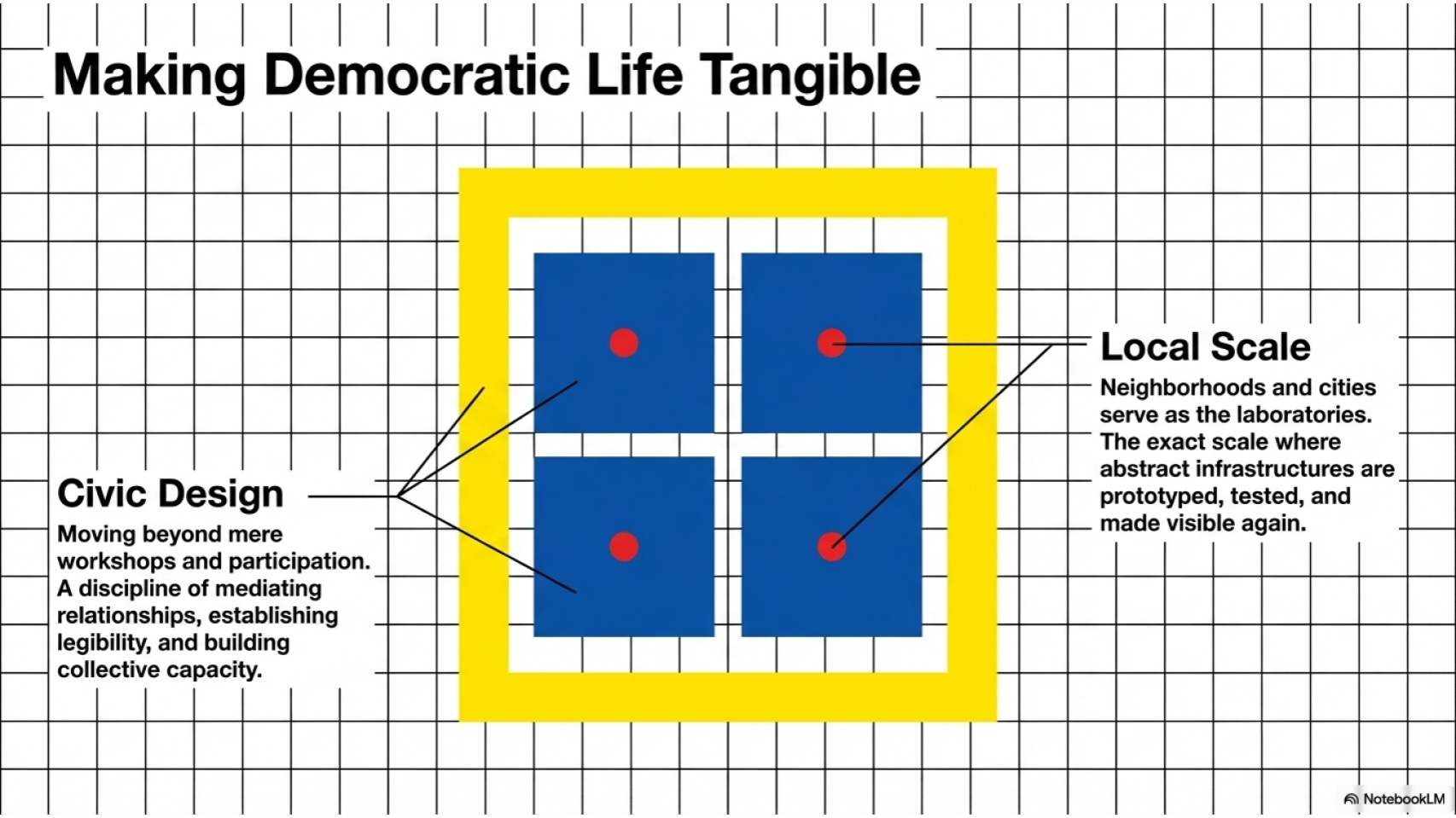
This is why local initiatives matter so much to me. Not because the local is pure or inherently better, but because it offers a scale where infrastructures can be tested, relationships can be built and forms of public life can be made visible again.
Public Mesh will likely continue to be rooted in those situated experiments, especially where they connect local practice with broader democratic and technological questions.
A first editorial season
As I’ve been reflecting on all this, I’ve realised that Public Mesh may need a first foundational season of articles. Not a random collection of posts, but a coherent sequence that defines the field of inquiry.
At this stage, I imagine that first series around seven essays.
The first would explore democracy as infrastructure.
The second would focus on the spaces where democracy actually happens.
The third would examine the transformation from open web to platform dependency.
The fourth would address artificial intelligence through the lens of sovereignty.
The fifth would define civic design beyond participation.
The sixth would look at the attention crisis and the erosion of the public sphere.
The seventh would return to the local scale and ask why democracy still needs places.
Together, these pieces would not offer a complete theory. But they would establish the intellectual territory of Public Mesh and make clearer what kind of publication it is becoming.
Still in motion
Perhaps the most honest thing I can say is that Public Mesh is still in motion.
It is not a finished brand or a perfectly defined editorial object. It is a practice of inquiry. A way of thinking in public. A place where I am trying to make sense of the infrastructures that shape democratic life today, while also experimenting with new ways of writing, organising and sharing that reflection.
AI has helped me move further and faster in that process, but the project is still deeply human in its uncertainties. It is built through trial, conversation, revision and the slow work of recognising what keeps returning.
So this is where I am with it for now.
Not at the end of the definition, but somewhere in the middle of it. Which, in many ways, feels like the right place to begin.